Showing posts with label music. Show all posts

Friday, October 17, 2008

Acoustic Smog, Headphones, and Your Ears

Maybe you just left the amphitheater from an amazing concert. Maybe you were mowing the lawn, working near a construction site, or at a Nascar race.
Or...you were listening to your iPod (or any music player) for an extended period of time.

Are your ears ringing?

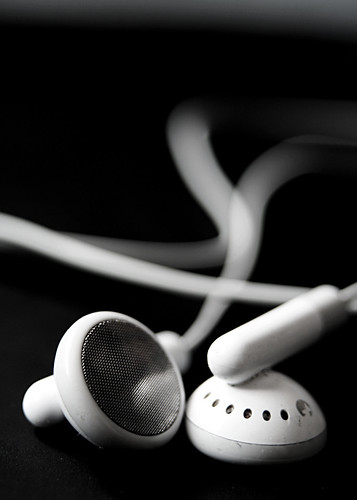
As a musician, especially one with rock band experience, I know. If your ears are ringing, they're hurtin' and being permanently damaged. A recent study written about in the New York Times showed that many people are listening to music at a higher concentrated volume than even the loudest workplace or factory. Even the iPod (which has an upper volume limit, should you choose to enable it), can put out more decibels than your ears can safely handle. Length of listening increases the chances that you're doing damage.

Sound is even affecting our wildlife, most notably whales, who are suffering because of acoustic smog coming from cruise ships, oil tankers, etc. Whales, like humans, communicate through sound. If they can't communicate, they have trouble finding mates, fellow pods, and raising offspring. TreeHugger has a great post about it.

I won't bore you with the science of hearing loss. In fact, I shouldn't have to. The simplest solution to preserving your hearing, is to follow my 3 rules:
  1. Listen through headphones at the lowest possible volume. If you need to "drown out" outside noise, consider getting noise-cancelling headphones instead of blasting the volume.
  2. Protect your ears, anything that sounds "loud" to you, probably is. Use ear plugs (or noise-cancelling headphones) while mowing, at rock concerts, car races, or in any job that deals with heavy machinery.
  3. Give your ears a break! After an hour of headphones listening, give your ears a chance to heal (and they will, provided you didn't do permanent damage, i.e. ringing or short-term hearing loss).
Please...take care of yourselves :)

photo credit: e-magic

Friday, September 19, 2008

Aural Theory & Dictation [Yes, you need to know this!]

As a music major in college, I had 8am ear-training lab (we called it "Guido" because of the software we used). It came naturally to me, but that's because I was a bass-player in a garage band, and before that (think middle school), I was a smartass kid taking bets that I couldn't figure out some show's theme song on my clarinet.
It's sad to me, as an educator, that ear-training, sight-singing, and rhythmic/melodic/harmonic dictation isn't taught more, especially at the high school levels. A favorite professor of mine always said,

"If you can't clap or sing it, you can't play it."

If your district doesn't offer aural theory, here are some things you can do on your own:
  1. Learn solfege and apply it to simple melodies, before tackling that district solo you're working on. 
  2. Got a song stuck in your head (known as an ear-worm)? Instead of trying to get rid of it, try notating it on staff paper. (use something like Finale Notepad to check your work!)
  3. Another fun experiment: play an "A" (440Hz) on a piano, tuner, or other instrument (see my iPod Touch post for another option). Then, go about your day. At lunch, hum the pitch. Are you close? If not, figure out how far off you were. Do this for a few weeks, and you'll have as close to perfect pitch as you can get. :)
Ear-training and dictation is a must-have for anyone claiming to be a musician. End-of-story. Want help getting started; need pointers? Email me or leave 'em in the comments.

photo credit: wrestlingentropy

Thursday, September 4, 2008

Web2.0 for Musicians

This is a rather long post, so I plan on dividing it into two parts: 1) Studying Music, and 2) Music for Studying (sorta). I'll be highlighting 4 websites that fall under the "web2.0" moniker, how I use them as a professional musician and educator, and their pros/cons. So, with that, on to part 1!

1) Studying Music
I remember sitting in a "listening room" in the library with a pile of CDs, my textbook, anthology, and my personal class notes. While I haven't had a music history class for about 7 years now, I still listen daily, as I believe it's the most important thing a musician can do. Now, though, I'm using better tools for the task.

Last.fm is one of my new favorite sites. When I'm studying an artist, or style of music, Last.fm is the first place I turn. You log in, do a quick search ("Yo-Yo Ma" for example), and it returns tracks and videos relating to him as an artist. You can also stumble through music of a specific genre, looking for new jazz music, for instance. Last.fm keeps track of what you listen to on your iPod (via "scrobbling"), and will suggest similar music as well.

Blip.fm is a relatively new site for me. It seems like a Twitter-like company, with a DJ spin on things. You can search for an artist or song, and "blip" it, allowing you to play it immediately (or later if you wish). While the faq is still pretty confusing to me, I can envision uses for blip.fm (a music professor creating a timeline of pieces to listen to, for example, or members of a cover band sharing ideas to each-other for future covers. The possibilities are endless!

2) Music for Studying
There have been quite a few studies done on music and how it effects the brain, including The Mozart Effect, and my favorite current book, This is Your Brain on Music, by Dan Levitin. In addition to actually listening to "music", though, the advantages of "white noise" and even "binaural beats" have been lauded as ways to focus on your work, shutdown headaches, and cure insomnia, among others. Here are my two favorite sites for focusing on my work.

SimplyNoise.com is simple that. The site offers an online stream of white noise, pink noise, and red/brown noise. They refer to Wikipedia to explain the differences, and the effects/benefits of using white noise. Find the desired volume, using the slider, then get to work blogging, studying, filing, or whatever you need to focus on. I can vouch for simplynoise as I've gotten into meditation and reading; two things I could never focus on before because of background noise stealing my attention.

I Dose is probably the most interesting in part 2 of my post, but also the one with the most debate as to its effectiveness. I Dose offers streams of "binaural beats". Essentially, binaural beats are 2 different frequency pitches played simultaneously, but coming from separate sides (they are best listened to through headphones). Your brain takes the difference of the two frequencies (in Hertz), and creates a wave at that frequency (which can then alter your mental state). If you find yourself struggling with writer's block, for example, lie down, close your eyes, and listen to this one for 15-20 minutes and give writing another shot.

If you try any of these out (or have previously), let me know in the comments! Am I missing any other great web2.0 music sites?

Thursday, August 28, 2008

Streaming Live Music

Whether you are a classical musician looking for places to perform, or a guitarist/songwriter trying to promote him/herself on your own, the internet is something you should be aware of AS A TOOL. You can use streaming as a way to broadcast your music anywhere in the world! It's something that takes some finesse to setup correctly, but with the right know-how, it's incredible valuable as a means of getting your music out there, giving you motivation to practice, and who knows!
About 3 years ago, I Skyped in to an Irish fiddler and played some of the jigs and reels I had been working on on my own. He gave me some incredible pointers about style, and taught me how to string playlists together. My fellow teachers were amazed at the technology, using my laptop (no webcam at that time), a small lapel mic, and the school's wifi, I was able to collaborate with a professional musician on the other side of the globe, over my lunch break, without leaving the building!
So, while some people believe that Second Life is a waste of time, and of no educational or learning value, I am getting the opportunity to perform live inworld for people I've met all over the world. They'll get to hear me live, without me leaving my small, studio apartment, using only computers and internet connections. Imagine the ability to perform live without all the performance anxiety, travel expenses, and moving of gear (always my favorite part).
If you're in SL, check out some live performances inworld! If you're in today, come to Misfits Underground at 3pm (slt)/6pm EST and hear not only me, but a fantastic vocalist, "PhoebeAnn Theas", followed by an open mic. It's taken me a long time to get into playing over the net, but thanks to my girlfriend, Cecily, I now have a venue, and a small set of live tunes worked up.

Wednesday, August 20, 2008

How would *you* say goodbye to your students?

I'm leaving the school district I taught in for two and a half years, suddenly. It sucks, but it's PA's Educational Law, that dictates that I had to get 24 post-graduate credits to enable me to continue teaching with my certificate. So, everything was last minute, because I was desperately trying to find a way to stay.
Instead, I was forced to resign suddenly, leaving staff, and more importantly, students, wondering what happened.
Because of the Facebook group for the orchestra, I have many students asking what happened, so I decided to write them a letter. I had to resign via letter, so this is my Resignation Letter to the Students (linked to Google Docs). I debated whether or not it was appropriate, had a few friends proofread it, and finally decided, it was necessary. Frankly, I don't care about the PA Dept of Ed, the district's administration, or how they're going to fill my vacant position. The only thing I care about, are the students, their parents, and making sure they still work regardless of who's there encouraging them to practice, learn, and love music.
Keepin' it short. If you have thoughts, or questions...well, you know.

Thursday, August 14, 2008

Audacity (free recording and practice tool?)

Throughout high school and college, anytime I was working on a piece of solo literature, I was told two things:
1. "Listen to recordings and other performances of the piece."
and
2. "Record yourself so you can listen back."
Today, I'm sharing a way to do the second piece of advice freely, simply, and using technology you probably already have! If you can operate a CD player or VCR (I'm not talking about programming it, either!), you can run Audacity on all three of the major operating systems (Mac OSX, Windows, and Linux). Other equipment: a microphone, headphones (not required, but recommended for doing multitrack recording), and obviously, the computer.
I've actually used Audacity, a small lapel mic, and my iPod headphones to record small pieces I've composed for violin, cello, and voice on my laptop! "For a Reason" (hosted on my Tumblr account) is one example of what you can do, freely, easily, and with very practically no recording experience. Seriously, the big red circle, which is commonly recognized as a "record" button: press it and play!
I doesn't need to be said, but Audacity is great for podcasting as well. Light enough for recording simple speech, and powerful enough to get well-recorded musical thoughts digitally recorded. I've played with some of the advanced features like noise reduction, effects, and beat-matching, so professional-quality recording is possible. Of course, you'll get better results with higher quality microphones, processing, and recording environments, but for what I do...Audacity is a win.
Use Audacity, or other recording tools for practice and composing? Have tips you want to share? Leave 'em in the comments for me!

Wednesday, August 6, 2008

iPod Touch for a Musician


I am a musician, and a teacher, and a tech-gadget hog. So when I was looking for a new music player before my Disney trip with the music department, I splurged on a 16Gb iPod Touch.

I am a firm believer in the "listen, sing, play" mentality, so a portable music player is almost a must-have in my eyes. One of the first things I do after I've sight-read through a new piece, is find a few recordings of it to study. Sometimes I'll play along. Other times, I just listen and try to imitate.
With the software upgrades and the opening of the App Store, my iPod has become even more useful. I grabbed MooCowMusic's "Piano" app, allowing me to tune my violin/cello from a full 88 key piano, record simple chord progressions and play them back, and devise simple melodies for future compositions. The "Remote" app, allows me to control my iTunes on my laptop when I need a louder accompaniment (or when I have it running through a sound-system) all via wifi.
Also, as long as I'm wifi connected, I have handheld access to my Google apps, where I can search my lyrics, use the calendar to keep track of when/how often I practice (and what I worked on), and more.
Honestly, if you're searching for a new music player and can afford it, I'd suggest the Touch without question.
Let me know in the comments, if you're a musician, and currently use the iPod Touch (or iPhone) as a practice tool.

photo credit: "iPod Touch" by tibopoix.

Saturday, August 2, 2008

Why is it so hard to practice?


Students aren't practicing as much as they used to.
Maybe that's just my own observation, or maybe it's partially true. There are a few reasons, I think.

  1. Kids are much busier now than they once were - with karate, dance, homework, sports, etc, they literally don't have enough time in the day to do it all.
  2. Families are much busier - not only are the kids busier, but parents and siblings are often doing many different things within the home, making practicing much more difficult (finding a quiet place, sans distractions).
  3. Schools aren't providing the motivation children need now. Being "in band" isn't enough anymore, especially with the negative stereotypes and self-esteem issues that come part and parcel with belonging to a clique.
  4. Encouragement at home isn't what it needs to be.

Now, obviously, if your child is routinely practicing, and making steady improvement, most of those excuses don't apply to them.
One of the saddest things I heard this summer was, from one of my 8th graders, "My parents don't let me practice because while my mom is in the kitchen cooking, my dad is watching tv, and my brothers are working on homework. Practicing would be a distraction." Thinking inward to my own habits, my practicing has suffered for a number of the same reasons: apartment living, background noise (a/c, fan, dehumidifier), and time.
Solutions are forthcoming in a future post, as I think about this more. If you have thoughts, leave 'em in the comments!

photo credit: Jason Tromm

Sunday, May 18, 2008

Cellphones and Music Education (a thought?)

Next week, I meet with a committee of administrators, students, parents, and education association members to discuss next year's cellphone policy for our school district. The consensus so far, is that cellphone abuse is worse this year than it ever has been, so we're going to tighten the rules and enforce them even more. My stance is that we'll never be able to keep up with the policies that are already in place, let alone tougher ones. I believe if we talk about respect and "the right place and time", we'll have more luck and less disruptions. With all that said, here's a thought on how I could use the handsets in an educational manner.
Here are a few samples of Essential Questions I've used as of late:

  • "How does ear-training improve my playing alone and in an ensemble?"
  • "What are some different techniques for memorization of music?"
  • "Why do we review and critique our performances and the performances of others?"
  • etc...

My cellphone, an LG Shine, has texting, camera, and audio/video recording capabilities. What if students could use their handsets to record their practicing during the school day (since computers or our advanced recording equipment is bulky and time-consuming to set up)? What if they used Twitter to keep track of practice at home? I realize video recording isn't available on every cellphone, but recording video would give students an insight on their posture, bow grip, performance quirks, and so on. I have a post in draft about using Skype for distance-learning lessons, but there's nothing stopping a student from placing a cellphone on a music stand (on a call) with me as they play from home, right?

Handheld electronics are not going away, and the sooner we all realize that, the less stressful we will be. How can we change policies for the better and start to take advantage of the portable nature of these tools?

Tuesday, May 6, 2008

Copyright vs. Creative Commons Education

My students ask me every time I do it:
"Are you copying that illegally? Did you ask permission? My Dad recorded the concert. Isn't that against the law?" etc

They're smart. Some of them even ask me about Creative Commons now that I've shown them some of my compositions. The biggest thing we're missing, is a time and a place to educate these students about Copyright, Fair Use, and Creative Commons.
I'm trying to gather information and wrap my head around it all enough to offer a lesson (possibly even an after school workshop) on the differences. With the press about Nine Inch Nail's latest albums (Ghosts I-IV and The Slip), it gives me a teachable moment to warn them about illegal downloading, plagiarism, copyright infringement, etc, BY offering legal alternatives.
So here's where I ask for help. My plan is to use a simple Google Docs presentation, including some NIN music as a hook, with the goal of having the students understand what we can and can not do based on the various licensing options of intellectual property. If anyone's done this already, I'd love some pointers. By Monday, I will have the presentation published, and will welcome anyone to collaborate if they wish.
Is this something that should be done more often with our students? Are we blindly assuming that they understand the law and differences between copyright, creative commons, and fair use?

Saturday, March 22, 2008

3 things I learned from a thrash-rock show

If you know me well enough, you know I'm a musician, but more specifically, a music teacher. I am a cellist, violinist, and composer. Music theory is to me what theorems and proofs are to mathematicians.
Every once in awhile, though, I expose myself to music outside...way outside...my normal everyday experiences. Tonight, I went to a thrash-rock CD release party.
I learned some things about music, believe it or not. Things teachers would NEVER be taught in college or during professional development. I learned some things about life that wouldn't be taught as part of character-ed lessons. So, here's my three biggest observations from attending a thrash-rock show:

  1. Listen to EVERYTHING. This is THE most important thing I can teach a musician or a music student. My ex-wife used to complain of headaches and car-sickness anytime I played something that she didn't know the words to. John Cage said (I'm paraphasing) that everytime you are given a piece of music to listen to, you're placing limits on what you understand as music. The more variety you hear, the bigger the umbrella of "music" you can appreciate, whether you enjoy it or not.
  2. "Loud" is not always called "forte". Our musical notation system is complicated. We still use Latin and Italian words for things, notes are placed on staves with heads, stems, and flags/bars, and instruments can be based around different keys. Just because music isn't written down, doesn't mean it isn't music. I take a step back occasionally, and force my violin, viola, and cello students to improvise. The National Music Standards may then advise me to have them try to notate it, but it doesn't always need to me. Some bands (like the 3 I heard tonight) have everything memorized, with only a set-list taped to the floor to remind them the order they want to play the songs in. When's the last time you memorized an entire concert?
  3. Don't assume ANYTHING based on the music someone likes. Yeah. I went to a thrash-metal-punk show, and enjoyed myself. I almost bought a copy of the cd they were releasing. You only need to go as far as my iPod to know that I'm not all Bach and Beethoven. You'd also never think of me as a music teacher if you caught me at a punk show like this, right? You know what happens when you assume, right?...

Finally...(yeah, this is number 4), it's amazing what a little networking will get you. The drummer of the second band I heard, works with me at Weis Markets (which is my 2nd job since teaching doesn't pay enough to survive on a single salary). He was leaving early for the show, and most of the others were attending. They all know I'm a musician/teacher and invited me...just for the heck of it. It was a bonding experience, and I'm actually looking forward to working again next Friday. Hopefully, we'll make the Facebook connections, I'll get some more pictures tagged with me in 'em, and I'll be invited to more musical experiences.

p.s. One of the other cake decorators sang a part of Carmina Burana today, and asked me to write down the title and composer so she could by the CD. (She's a 22 year old, culinary arts student who usually listens to Top 40/Rock)

Sunday, March 2, 2008

On Their Level (Seussical '08)

Thanks cast for the adorable Yertle the Turtle and Hop on Pop
The past few weeks have meant spending my entire day at the high school for musical rehearsals, eating fast food, having a spare change of clothes in my trunk, repairing instruments, oh yeah...all while continuing to teach my middle and elementary school string players.

Yes, it is an extreme amount of work/time when you commit to play in a musical.

But...it's worth it! This year, Northern York County School District decided to put on Seussical the Musical at the high school. Some of the best students are in the cast, playing in the pit orchestra, running lights/sound, stage crew, etc. Friday night was our opening night, and it went extremely well. Tonight's performance was equally amazing, with our only snag being the air-conditioning in the theater not working (add spot and stage lights, and almost 1200 people, and it gets into the 90's without a/c).
The most fun, though, is because I'm a young teacher, I still relate to the kids very well. Sometimes too well, to the point where I have to remind myself that I'm still required to be "mostly" professional around them. That said, last night at Al's (amazing subs!) I was one of the last to leave, but we had a great time joking, telling stories of past musicals, band trips, rehearsals, etc. After tonight's show, was the "official" cast party at one of the student's houses. While all but one director showed up, I ended staying until a little after midnight. My junior cellist, bribed me to play DDR against the party's hostess (my cellist is an amazing cook/baker, so she bribed me with cupcakes). The bass player and lead crew-man both talked about their after-party plans to "LAN-it-up" playing World of WarCraft and StarCraft, and invited me to check out their LAN-party setup. I am officially on a few of their Facebook friends lists, and I'm sure more will be coming (especially when the photos are uploading from all the cameras!).
I try to ask myself, "Is this acceptable?" but I remember that most teachers didn't have this technology and these skills even 5 years ago. When my string quartet students are using the WikiSpaces discussions to ask me questions outside of the school day, students are emailing me when they've practiced, and videos links are shared with me through YouTube, I can't help but think this is the way of the future...

Monday, February 11, 2008

String Quartets Project

Chamber music has always been a dream of mine. It's probably the most musically and mentally challenging thing a musician can do. Practicing on your own, you're an individual. Rehearsing in a large ensemble, you just add your sound to the mix. In a chamber ensemble, you have to contribute 100% or your part is lost.
My epiphany came the other day while working on the WikiSpace for our String Quartets project: Chamber Music is the paradigm of collaborative pairing! There are clear, obvious goals of every ensemble (perform the music correctly, teamwork, nonverbal communication, planning/scheduling/booking performances, etc), and the only way those objectives can be met, is by the entire ensemble working together.
So here's a quick breakdown of the project, then I'll share the WikiSpace, which is still in it's infancy.

  • High School String Quartet is formed by teacher selected-students.
  • High School and Middle School orchestra students not in the H.S. Quartet are given form to create a quartet, find a rehearsal time, and decide on a name (based on our district's mascot/theme).
  • Rehearsals will be set up and music can be chosen both by the ensemble, and the orchestra director, (who acts as a coach for all ensembles).
  • Each ensemble will be responsible for managing their part of the WikiSpace, including performance photos, upcoming performances, repertoire, etc.

I'm going to leave you with the link to the Northern String Quartet's WikiSpace. It's completely open (the way a Wiki should be) if you have something important to contribute. The High School group, The Northern String Quartet has it's first performance on the 23rd of February, 7:30pm. If you're in the Central PA area, contact me and I'll get you more information!

Friday, January 25, 2008

Tumblr

Everyone knows I'm a Twitter addict. It's ease of use, complete mobility, and constant stream of information, humor, insight, and thought makes it one of the best Web 2.0 tools I've seen since the bubble began.
What you may not realize, is that in addition to Twitter, I also have accounts with Pownce, Jaiku, and now my second favorite, Tumblr.
Tumblr's great claim to fame: sorting by post type. You can post "Text", "photo", "quote", "link", "chat", "audio", and "video" categorized posts in your Tumblr tumblog, and sort all the posts using those categories. Me being a musician, but always coming up with new ideas, recording scratch tracks, and never recording final mixes, my Tumblr is great for sharing some of those audio clips. Now, since most people don't care about all my fed Twitter posts, I give them this link: http://www.tumblr.com/show/audio/by/me.
A few more nice things about Tumblr:

  • Complete customization of your template (with a premium account)

  • Channels (share certain items with a select group of people)

  • Following (works similarly to Twitter)


Lemme know if you check Tumblr out, and please share your thoughts with me. If you're brave enough to listen to some of my audio clips (you can only post one per day, presumably to avoid music piracy), feel free to tear me apart in comments here as well.

edit: I just realized that the link I posted for sorting will *NOT* work for non-logged-in viewers. It looks like it will only sort on your dashboard, and for people you are following...Gonna try to suggest an actual sorting feature though.

Friday, January 11, 2008

iPods for the musician

This morning, was a small ensemble day at the High School. To make things even more interesting, I was missing two of my normal orchestra students to the Principal's Cabinet meeting, giving me a group of only 5 people. So, after running through a couple trouble spots, and building scale practice, it felt silly to try to work on concert repertoire without the full crew.
Interestingly, one of my violinists asked if she could listen to her iPod. Instead of saying no because of the district policy, I redirected her request by saying, "If you'd like to listen to a song and try to figure out parts of it on your violin, sure!" (Assuming that she just wanted to listen to music and not actually practice) A few of my other students' ears perked up when I made that option available to them this morning. My two 9th graders who are playing in our pit orchestra for Seussical, both have their rehearsal CDs uploaded to their iPods, so this gave them a way to practice. When my junior violinist made 11th chair for districts, I found the recordings for the pieces and instead of burning a CD, let her import them to her iPod. I even use mine for jazz improvisation, listening to interpretations of Bach Cello Suites, and even tuning! Yes, I have a tuning note track saved to my iPod Touch so I can listen, and tune my instrument that way.
Now, there are a few things I'd like to do using iPods to make practicing even better. I'd love to be able to plug my iPod into a set of good speakers so the ensemble can hear a preview of a new piece, a classical example, or for group improvisations. I'd love to be able to do some podcasting and have every student subscribe to it. Students could even record compositions or improvisations using Audacity, then do a weekly podcast showcasing some of those works!
Are you a musician? Do you use an iPod to enhance your practicing?

Thursday, December 20, 2007

"I didn't practice because..."

Yes, a music post, but don't worry. This stuff is useful for anybody, whether they're musical or not.
It never fails. We as music educators will always have those couple kids that never practice. They always have an excuse, and most times, it's an excuse that I've used myself. So what do we do? I have the answer...partially

I'm leaving for Philadelphia tomorrow evening, without either of my instruments. You may be wondering, "How is he telling his students to take their instruments home and practice, yet he's leaving both his locked up in the apartment for a week? Kinda hypocritical don'cha think?" Well...yes and no.
Here are some things as a string player, but more importantly, as a musician, that you can do to practice even without your instrument. Many of these tips, I do everyday. Some, I'm even able to do while I'm driving, eating, and just about to doze off into dreamland. So here they are, in a nice, compact list:

  1. LISTEN - You should be doing this daily no matter what. Listen to the pieces you're working on, listen to new music, listen to music concrete (everyday sounds from life). The more you listen, the better you can make musical choices in your performing.
  2. Stay in Shape - I don't necessarily mean going to the gym, because I surely don't. But if you're a brass player, you can easily take your mouthpiece with you and "buzz". String players can practice fingerings (I haven't ruled out Guitar Hero yet, either), and small-muscle training. Any musician should be practicing slow-breathing and can easily be combined with a simple form of meditation.
  3. SING - Just because your instrument isn't with you, doesn't mean you can't take your music and sing the parts. And no, I don't mean like Placido Domingo. It doesn't have to be perfect, but the pitch should be correct. I end up teaching 60% of my concert literature to my orchestras via me singing the parts. I'd even wager that I sing more than most general music teachers in the course of a school day. Singing your music commits it to a different memory mechanism than playing it or listening to a recording of it.
  4. Be CREATIVE - Your instrument isn't your only creative outlet. Sing (see above), draw, paint, make up games outside, etc. Something as simple as trying to do a routine task in a new way (a friend of mine made spaghetti with meatsauce in a coffee-maker once, blew me away with the idea!) can jog your creative side of your brain.
    And finally,
  5. Keep TRACK - Seinfeld uses a 30-days system to learn a new habit or routine, where-in he crosses off the day on a calendar every day he completes that task. It's much harder to break a "streak" when you're keeping track of it. Conversely, it's much harder to get back into it once you've skipped a few days, and the streak isn't so impressive. Everyday you practice (or do one of the things from my list), make a note of it on a "practice calendar".

There ya go! Got any more reasons for me? I'm about to sit through a re-run sitcom and practice some scales and Irish jigs. What's your excuse?